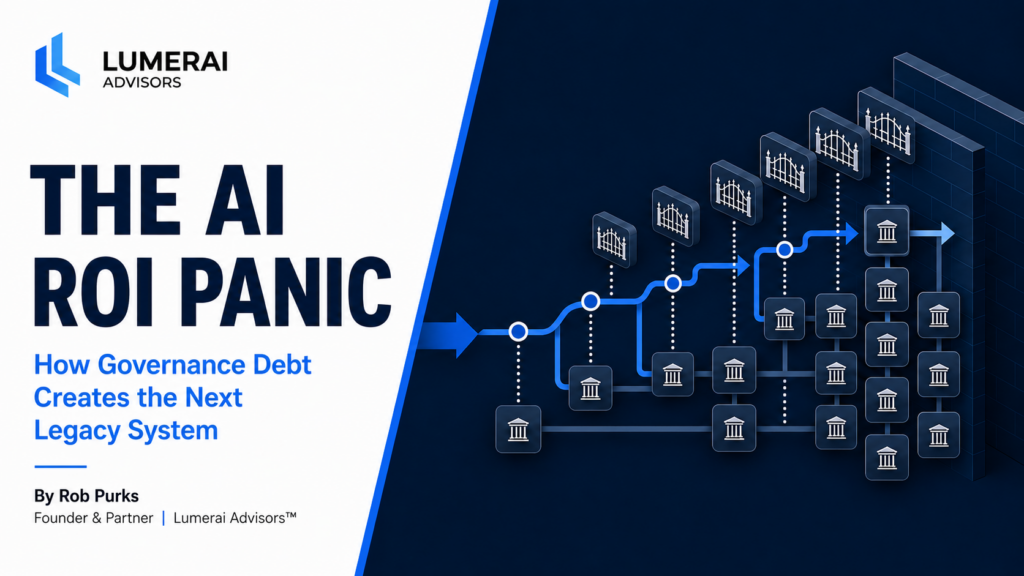
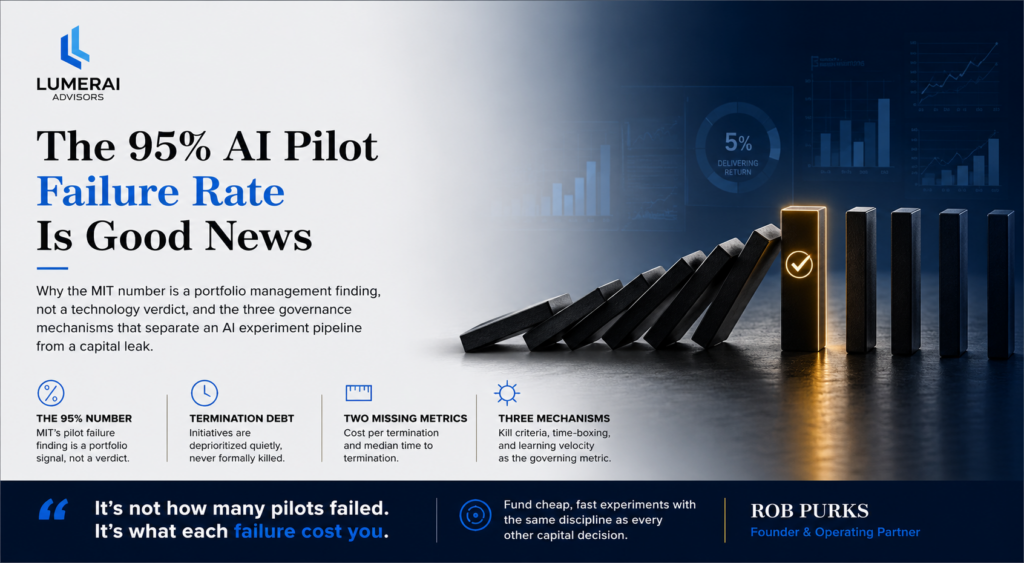
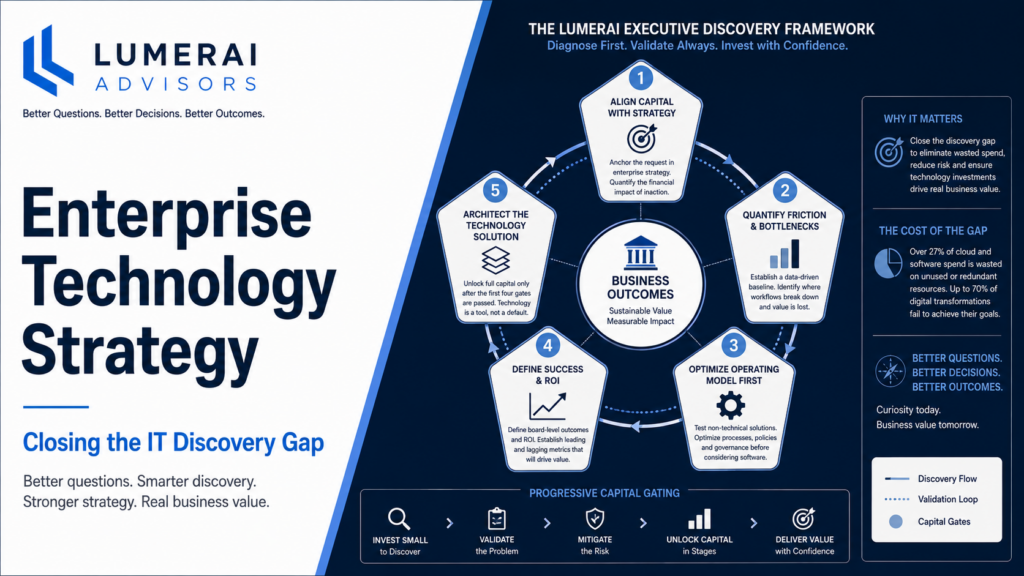
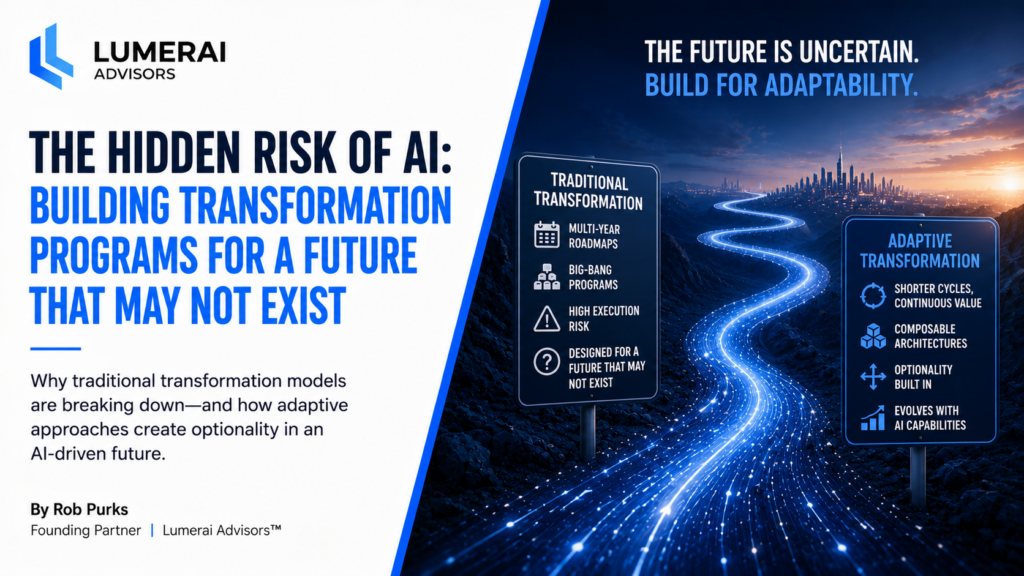
The modern CIO is no longer a technologist — they’re an architect of enterprise decisions

For much of the last three decades, the CIO role has been defined by delivery: platforms implemented, systems stabilized, programs executed. Success was measured in uptime, milestones, and budget adherence. When things went wrong, the diagnosis was familiar — execution struggled, teams moved too slowly, or technology didn’t perform as expected. That framing is no longer sufficient. Most large-scale enterprise modernization efforts do not fail because teams cannot execute. They fail because the strategy and structural decisions were flawed from the start — and those flaws quietly harden long before delivery ever begins. In today’s enterprises, technology outcomes are rarely constrained by tools or talent. They are constrained by how clearly leaders define outcomes, how explicitly they make tradeoffs, and how intentionally they design the decision systems that translate strategy into action. That is why the modern CIO is no longer simply accountable for technology execution. They are increasingly accountable for the decision systems that determine whether transformation efforts ever translate into durable business value. I’ve come to believe this is the real evolution of the role. The modern CIO is no longer primarily a technologist. They are the architects of enterprise decisions. Where transformations actually fail I’ve been brought into many programs described as “behind schedule” or “underperforming delivery.” On the surface, they appear to be execution problems. Teams are busy. Roadmaps exist. Progress is tracked. Yet outcomes continue to disappoint. When you examine the root causes, the issues are rarely about effort or capability. They’re systemic. The same patterns appear again and again: No clear definition of business outcomes Competing priorities with no tradeoff discipline Governance models that reward activity instead of impact Operating models misaligned to how work is actually done Architecture decisions driven by politics rather than strategy Funding models that fracture accountability When these conditions exist, delivery does not experience random issues. It degrades predictably. Velocity slows. Dependencies multiply. Decision latency increases. Risk accumulates. Costs escalate. Credibility erodes. By the time leadership starts asking why execution is failing, the failure is already baked into the structure. This is where modernization efforts most often go wrong. Leaders declare a new strategy, but they leave the underlying decision architecture intact. Old governance models are asked to support new operating realities. Legacy funding structures are expected to enable adaptive delivery. Accountability remains fragmented while outcomes demand cohesion. Execution is then asked to compensate for design failure. It never does. Research published by McKinsey has consistently shown that organizational and operating model constraints — not technology — are among the primary reasons large transformations stall or reverse course. The more profound implication is often left unstated: if the constraint is structural, accelerating delivery without redesigning decision systems simply reveals the weakness more quickly. The CIO’s real leverage point Modern CIOs sit at a unique intersection of strategy, execution, and governance. They see where priorities collide, where accountability blurs, and where decisions stall under the weight of ambiguity. Historically, CIO influence was exercised through control of technology assets — budgets, platforms, architecture standards, and delivery capacity. Today, the CIO’s most consequential influence is exercised upstream of delivery, in how decisions are designed and governed. This is less visible work than a cloud migration or platform rollout, but far more determinative of outcomes. In practice, the CIO becomes responsible for orchestrating intelligence and ensuring that strategy is supported by structures capable of executing it. That requires deliberate design across several dimensions. Outcome clarity.What are we trying to achieve, and how will we know? If outcomes are vague, success becomes subjective and tradeoffs become political. Decision rights.Who decides what, and at what altitude? When decision ownership is implicit, authority defaults to whoever can delay the longest. Tradeoff discipline.When priorities conflict — and they always do — how does the organization decide? What data is required? Who arbitrates? How long does it take? Without a mechanism, alignment becomes theater. Governance that enables movement.Governance should resolve ambiguity, not preserve it. Committees that exist primarily to distribute blame will reliably slow progress. Operating model alignment.Declaring “product teams” does not create product accountability. If funding, incentives, and authority remain project-based, the operating model is performative. Sequencing and capacity management.Every organization has finite change capacity. Strategy without sequencing diverts leadership attention and creates the illusion of resistance, when the real issue is design failure. When these elements are intentionally designed, something important happens. Execution becomes less dependent on heroics. Teams stop waiting for permission to solve obvious problems. Leaders stop relitigating the same tradeoffs. Delivery begins to resemble a stable operating rhythm instead of a constant escalation. This is the CIO’s real leverage point. Not tooling. Not velocity. But decision integrity. What boards increasingly expect from cio leadership Boards and executive teams are beginning to recognize this shift, even if they don’t always articulate it in architectural terms. They rarely ask about specific platforms or methodologies. Instead, the questions sound like: Why does this initiative keep stalling at the same point? Who is accountable when priorities conflict? How do we know this risk is understood rather than deferred? What will break if we scale faster? Are we building durable capability or just shipping activity? These are not technical questions. They are governance and decision-design questions. Boards understand that digital transformation is no longer a discrete program. It is an ongoing operating reality. As a result, they are increasingly looking to the CIO not just for delivery competence but also for judgment—the ability to translate strategy into repeatable, governable execution. MIT Sloan Management Review has written extensively about the importance of explicitly designing decision rights and governance structures to sustain transformation outcomes. Organizations that do this well tend to move faster with less friction because ambiguity is no longer the default operating condition. This is why the modern CIO is increasingly viewed as a peer enterprise leader rather than a functional specialist. Boards do not need another executive who can “run IT.” They need an executive who can shape how the enterprise changes without losing control. The

The Architecture of Authority: Why AI Is Breaking the Traditional Corporate Hierarchy

Digital AI profile and organizational hierarchy diagram illustrating how artificial intelligence is changing authority, decision-making, and leadership structures within modern enterprises.

AI is no longer just informing decisions. It is beginning to make them. As intelligent systems take action independently, traditional corporate hierarchy, accountability, and governance models are starting to break. This article explores why decision architecture is becoming a core leadership issue for the modern enterprise.

This will help with archive pages, social previews, and internal site presentation.

From Systems of Record to Systems of Judgement

Why enterprise architecture must evolve in the AI era. Several years ago, I sat in a boardroom reviewing what was, at the time, the largest technology investment in the company’s history. A full-scale modernization of our core platform. The business case was disciplined and compelling: operational resilience, regulatory durability, scalability for growth, and long-term cost efficiency. The system of record that anchored the institution would be rebuilt for the future. It was the right decision. Three years later, the platform was stronger. Transaction integrity improved. Audit exceptions declined. Infrastructure stability increased. The ledger was clean, reconciled, and defensible. And yet, something important had not changed. Customer friction remained inconsistent. Cycle times remained uneven. Risk decisions varied across teams. Operational bottlenecks migrated upstream. We had modernized how the enterprise recorded transactions. We had not modernized how the enterprise made decisions. At the time, that felt like an execution gap. In retrospect, it was architectural. The Era of Systems of Record For decades, enterprise technology strategy revolved around systems of record. Core banking platforms. Loan origination engines. Servicing systems. Enterprise resource planning environments—policy administration systems. General ledgers. These systems are designed for determinism. They enforce rules, validate inputs, reconcile balances, and ensure compliance. They answer retrospective questions: What happened? Was it processed correctly? Is it compliant? Can we prove it under regulatory scrutiny? In financial services, healthcare, insurance, and other regulated industries, systems of record are existential. Without them, there is no institutional credibility. They are the foundation of trust. Over the past twenty years, billions of dollars have been invested in strengthening these systems. Legacy cores have been replaced or wrapped. Cloud migrations have accelerated. Data warehouses have become data lakes. Cyber resilience has improved materially. This work has been necessary. But it has also created an assumption: that once systems of record are modernized, performance will naturally follow. Increasingly, that assumption is flawed. Because competitive advantage has shifted away from how well institutions record transactions — and toward how well they decide before and after those transactions occur. The Quiet Rise of Systems of Judgment Artificial intelligence, machine learning, and advanced analytics have introduced a structurally different layer of enterprise capability. Not a replacement for systems of record, but something orthogonal to them. Call them systems of judgment. A system of judgment does not merely store or process transactions. It synthesizes structured and unstructured data, applies probabilistic reasoning, evaluates risk trade-offs, and produces contextualized recommendations. It may automate the decision entirely or augment a human operator. It learns from outcomes and refines future behavior. It answers forward-looking questions: Should we approve this borrower? Is this transaction anomalous? Which customers are at risk of attrition? Where is operational risk emerging? Which capital allocation will maximize risk-adjusted return? These are not deterministic questions. They are probabilistic. They involve uncertainty, trade-offs, and policy interpretation. Historically, this kind of judgment lived in committees, experienced operators, policy binders, and institutional memory. It was distributed, often inconsistent, and difficult to scale. Today, enterprises are encoding judgment into software. Underwriting engines incorporate machine learning models. Fraud detection systems monitor behavioral anomalies in real time. Marketing personalization engines predict engagement likelihood. Operations platforms prioritize work queues dynamically. Decision-making is becoming digital. That is a profound architectural shift. Why This Shift Is Different From Past Technology Waves Previous waves of enterprise modernization focused on automation and efficiency. The goal was to reduce manual effort, eliminate redundant systems, and improve transaction throughput. Systems of judgment change the locus of value. The economic impact of a marginal improvement in decision quality can far exceed the impact of transaction efficiency gains. Consider credit underwriting. A small improvement in risk prediction accuracy can materially reduce loss rates without constraining volume. In fraud detection, earlier identification of anomalous behavior can prevent outsized losses. In pricing, more precise elasticity modeling can enhance margin without sacrificing competitiveness. These are not back-office optimizations. They are drivers of return on equity. In other industries, the pattern holds. More accurate demand forecasting reshapes supply chains. More precise diagnostic support improves healthcare outcomes. Better risk scoring transforms insurance loss ratios. The enterprise that decides better — consistently, transparently, and at scale — gains a structural advantage. But here is the complication. Most organizations have not architected for this reality. The Governance Gap in the Age of AI Decision Systems In many large institutions today, systems of record are mature. Data governance functions are established. Model Risk Management frameworks exist, particularly in regulated sectors. Cybersecurity oversight is board-level. Yet systems of judgment are proliferating without equivalent architectural clarity. AI models are deployed across business units. Decision engines are layered on top of legacy systems. Data science teams operate semi-independently. Human override mechanisms vary by domain. Escalation paths are informal. The result is fragmented judgment. No single enterprise map shows how consequential decisions are made end-to-end. Few boards can articulate which decisions materially drive economic performance. Even fewer can explain how those decisions are governed collectively. This fragmentation introduces both risk and inefficiency. Without a coherent decision architecture, AI initiatives may: Produce inconsistent outcomes across business lines. Embed bias in ways that are difficult to detect. Create opaque decision chains that complicate regulatory defense. Allocate capital toward low-impact use cases while ignoring high-leverage domains. The issue is not that AI exists. The issue is that institutional judgment is not deliberately engineered. Systems of record were designed intentionally. Systems of judgment are emerging organically in many enterprises. That is not sustainable. From Technology Modernization to Decision Architecture To understand the architectural gap, it helps to distinguish between platform modernization and decision architecture. Platform modernization focuses on infrastructure: replacing legacy systems, migrating to the cloud, consolidating applications, improving performance, and resilience. Decision architecture focuses on how data flows into models, how models inform actions, how those actions are supervised, and how outcomes feed back into learning loops. Platform modernization is necessary for stability. Decision architecture is necessary for an advantage. In the AI era, these two domains must intersect. Systems of record provide

The Governed Intelligence Overlay (GIO)

The Architectural Pattern for Distributed Intelligence in the AI Enterprise In the first installment of this series, I argued that enterprise architecture is undergoing a structural shift — from systems of record to systems of judgment. The Architectural Pattern for Distributed Intelligence in the AI Enterprise In the first installment of this series, I argued that enterprise architecture is undergoing a structural shift — from systems of record to systems of judgment. Systems of record remain essential. They provide transactional integrity, regulatory defensibility, and operational stability. But they do not differentiate. Systems of judgment — the AI-enabled decision systems that inform underwriting, fraud detection, capital allocation, personalization, operational prioritization, and risk escalation — are where competitive advantage now resides. The problem is not that organizations lack AI initiatives. The problem is that most enterprises have not designed an architecture for judgment. Intelligence is proliferating at the edge. Governance remains rooted in the core. That imbalance creates either chaos or paralysis. What is required is not another monolithic system. Nor is it another department. It is an architectural pattern. I refer to that pattern as the Governed Intelligence Overlay (GIO). Why AI Fails at Scale Before defining GIO formally, it is worth examining why many large-scale AI initiatives stall. In most enterprises, the pattern unfolds predictably: Business units deploy localized AI models to improve specific metrics. Data science teams build increasingly sophisticated predictive engines. Technology modernizes platforms to support real-time inference. Risk and compliance functions implement validation frameworks. Executives report AI adoption metrics to the board. Individually, these efforts are rational. Collectively, they often lack architectural coherence. Decision logic becomes embedded in disparate systems. Model governance operates in silos. Human override practices vary by function. Escalation paths are informal. Data flows multiply without unified consequence mapping. When a high-impact decision is questioned — by regulators, customers, or the board — the institution struggles to explain the full decision chain. The issue is not intelligence. The issue is design. Without an explicit architecture for distributed judgment, enterprises oscillate between two failure modes: Over-centralization — embedding decision logic deep in core systems to maintain control, sacrificing agility. Uncoordinated decentralization — allowing edge innovation without enterprise-level standards, increasing risk. GIO exists to resolve this tension. Defining Governed Intelligence Overlay (GIO) GIO — Governed Intelligence Overlay — is an enterprise architecture pattern that decouples intelligence and consequential decision-making from core systems of record, while embedding governance, traceability, risk alignment, and capital discipline directly into the decision layer. It is not a technology product. It is not a department. It is not a model validation function. It is a structural principle. GIO introduces an overlay between stable core systems and adaptive edge-based decision environments. This overlay allows intelligence to operate close to context — within products, workflows, and customer journeys — while maintaining enterprise-wide standards for explainability and oversight. To understand this pattern clearly, consider the following conceptual model. GIO Architecture Model Systems of record remain essential. They provide transactional integrity, regulatory defensibility, and operational stability. But they do not differentiate. Systems of judgment — the AI-enabled decision systems that inform underwriting, fraud detection, capital allocation, personalization, operational prioritization, and risk escalation — are where competitive advantage now resides. The problem is not that organizations lack AI initiatives. The problem is that most enterprises have not designed an architecture for judgment. Intelligence is proliferating at the edge. Governance remains rooted in the core. That imbalance creates either chaos or paralysis. What is required is not another monolithic system. Nor is it another department. It is an architectural pattern. I refer to that pattern as the Governed Intelligence Overlay (GIO). Why AI Fails at Scale Before defining GIO formally, it is worth examining why many large-scale AI initiatives stall. In most enterprises, the pattern unfolds predictably: Business units deploy localized AI models to improve specific metrics. Data science teams build increasingly sophisticated predictive engines. Technology modernizes platforms to support real-time inference. Risk and compliance functions implement validation frameworks. Executives report AI adoption metrics to the board. Individually, these efforts are rational. Collectively, they often lack architectural coherence. Decision logic becomes embedded in disparate systems. Model governance operates in silos. Human override practices vary by function. Escalation paths are informal. Data flows multiply without unified consequence mapping. When a high-impact decision is questioned — by regulators, customers, or the board — the institution struggles to explain the full decision chain. The issue is not intelligence. The issue is design. Without an explicit architecture for distributed judgment, enterprises oscillate between two failure modes: Over-centralization — embedding decision logic deep in core systems to maintain control, sacrificing agility. Uncoordinated decentralization — allowing edge innovation without enterprise-level standards, increasing risk. GIO exists to resolve this tension. Defining Governed Intelligence Overlay (GIO) GIO — Governed Intelligence Overlay — is an enterprise architecture pattern that decouples intelligence and consequential decision-making from core systems of record, while embedding governance, traceability, risk alignment, and capital discipline directly into the decision layer. It is not a technology product. It is not a department. It is not a model validation function. It is a structural principle. GIO introduces an overlay between stable core systems and adaptive edge-based decision environments. This overlay allows intelligence to operate close to context — within products, workflows, and customer journeys — while maintaining enterprise-wide standards for explainability and oversight. To understand this pattern clearly, consider the following conceptual model. GIO Architecture Model Two directional forces define this model: Trusted data flows upward from systems of record to decision systems. Governance spans across decision systems through the overlay. Intelligence decentralizes. Governance remains coherent. The Role of Systems of Record In this architecture, systems of record retain their foundational role. They: Maintain authoritative transaction history. Enforce deterministic processing rules. Anchor regulatory reporting. Provide reconciled, trusted data streams. Critically, they do not become the home of adaptive intelligence. When organizations embed probabilistic decision logic deep inside monolithic cores, they introduce rigidity. Every model update becomes a platform event. Every rule adjustment becomes a system

Operationalizing GIO

Governing Distributed Intelligence Without Killing Velocity In the first two installments of this series, I argued that enterprise architecture is undergoing a structural shift — from systems of record to systems of judgment — and that the appropriate response is a Governed Intelligence Overlay (GIO): an architectural pattern that allows intelligence to operate at the edge while preserving enterprise-level governance. That framing is necessary. But architecture only matters if it works under pressure. The question is not whether GIO is conceptually sound. The question is whether it can function inside real enterprises — particularly complex, regulated institutions — without creating bureaucracy, duplicating existing functions, or slowing innovation. Because if the overlay becomes a committee, it will fail. If it becomes a technology program, it will fail. If it becomes a checklist, it will fail. Operationally, the overlay must function as a control plane for consequential decision systems — translating architectural principles into enforceable standards without centralizing execution.   The First Principle: Governance Must Scale With Consequence The most common failure mode in AI governance is overgeneralization. Organizations attempt to apply uniform controls across all decision systems. The result is predictable: either friction or circumvention. Not all decisions carry equal consequences. A credit underwriting model does not carry the same risk profile as a personalization engine. A capital allocation decision does not have the same implications as an internal workflow optimization. The operational foundation of GIO is consequence tiering. Before governance is applied, enterprise decisions must be classified by their economic, regulatory, and reputational impacts. A practical model includes: Tier 1 — Enterprise-consequential decisions: Capital allocation, credit underwriting, AML determinations, material risk classification Tier 2 — High operational impact decisions: Pricing adjustments, major segmentation, service prioritization Tier 3 — Customer experience optimization: Personalization, recommendations, low-risk automation Tier 4 — Internal productivity augmentation Copilots, workflow assistance, low-impact automation Governance intensity scales with consequence. Tier 1 decisions require traceability, explainability, override logging, and executive visibility. Tier 4 decisions require minimal oversight beyond data integrity and monitoring. Without this scaling model, GIO becomes either bureaucratic or irrelevant.   The Second Principle: Map the Enterprise Decision Ecosystem Most organizations can produce an inventory of models. Far fewer can describe how consequential decisions actually occur. That distinction matters. A model inventory tells you what exists. A decision map reveals how the enterprise behaves. Operationalizing GIO begins with identifying: Which decisions materially affect capital, compliance, customer outcomes, or reputation Which models influence those decisions Where multiple models intersect Where human overrides occur How escalation pathways function Where decision logic diverges across business lines This mapping reflects a structural shift: decision logic is no longer embedded within core systems, but distributed across edge environments. The purpose of GIO is to govern that distributed layer without re-centralizing it. The output is not a system diagram. It is a map of enterprise judgment flows.   The Third Principle: Separate Execution From Standards The introduction of a governance overlay inevitably triggers resistance. Business leaders fear slowed innovation. Technology leaders fear duplication. Risk functions fear loss of control. GIO only works if it draws a clear boundary: Execution remains decentralized. Standards are defined centrally. Product teams continue to build. Business units retain decision ownership. Data science teams continue to develop models. The overlay defines what constitutes governed decision-making. It answers: What documentation is required for Tier 1 decisions What constitutes acceptable explainability When human intervention is required How override behavior is measured How outcomes are evaluated against economic targets When escalation is mandatory The overlay does not approve every model. It defines the conditions under which decision systems operate. This is the difference between a control plane and a gatekeeper.   The Fourth Principle: Integrate, Don’t Replace Large enterprises already maintain mature governance functions: Data Governance Model Risk Management Enterprise Risk Management Compliance Architecture Review GIO does not duplicate these. It governs how they intersect at the decision layer — where models, data, workflows, and human judgment combine to produce consequential outcomes. Data governance ensures data integrity. Model Risk Management validates model soundness. Compliance interprets regulatory requirements. Architecture defines platform standards. GIO operates above these — structuring how they interact within consequential decision systems. The organizational form may vary — often a cross-functional council or governance forum — but that structure is downstream of the architecture. GIO remains a design principle, not an operating unit.   The Fifth Principle: Align Capital to Decision Leverage Most AI investment portfolios are shaped by local demand and organizational enthusiasm. GIO introduces economic discipline. Once consequential decisions are mapped, leadership can assess: Which decisions drive the majority of economic value Where inconsistency introduces hidden risk Where marginal accuracy improvements create an outsized impact Which domains are under-engineered relative to their importance Capital allocation should reflect decision leverage, not novelty. Improving a high-impact decision system often generates more value than launching multiple low-impact initiatives. This is where GIO shifts AI from experimentation to engineered advantage.   Stress Testing GIO in a Fortune 100 Bank In a large financial institution, governance is already distributed: A CIO oversees platforms. A CRO manages risk. A CDO governs data. Business leaders own P&L. GIO does not sit within a single function. It introduces architectural coherence across them. It does not replace Model Risk Management. It does not duplicate data governance. It does not centralize execution. Instead, it provides a structured mechanism to: Classify decisions by consequence Map enterprise decision flows Define standards for high-impact systems Align reporting to executive and board oversight Evaluate AI investment relative to decision leverage The result is not reduced velocity. It is reduced ambiguity.   Stress Testing GIO in a Private Equity Portfolio In private equity environments, the challenge is different. Governance structures are often immature. Data is fragmented. AI initiatives are inconsistent. Here, GIO functions as an operating model. It enables: Rapid identification of high-leverage decision domains Introduction of scalable governance without bureaucracy Improved risk transparency ahead of exit Demonstration of engineered decision systems as a value driver For PE, the objective is not

Digital Employees Don’t Fail — Organizations Do: What AI Reveals About Leadership, Governance, and Operating Model Design

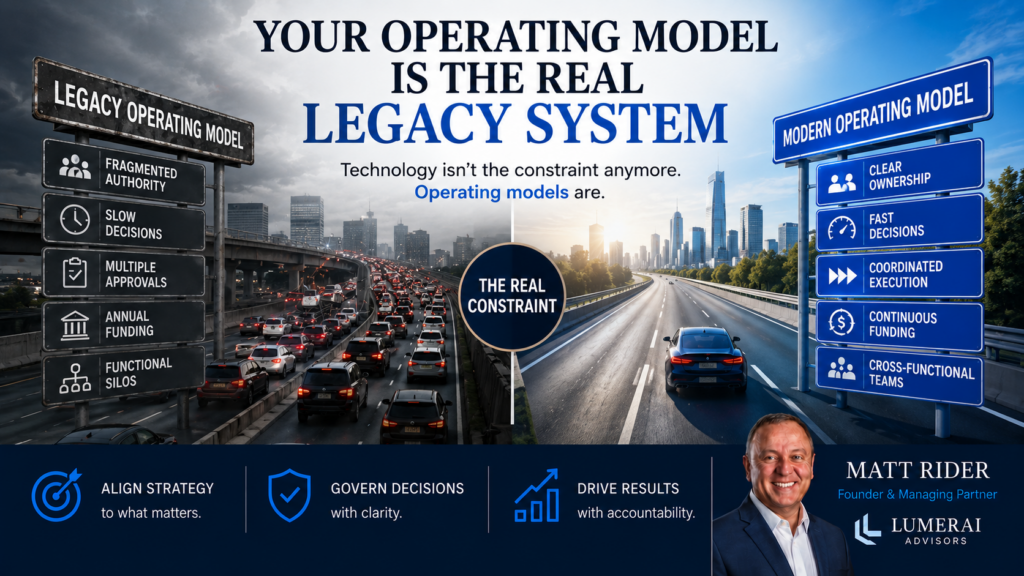
The uncomfortable truth about AI in the enterprise Artificial intelligence is no longer experimental. Digital employees now validate income data, monitor fraud, triage customer service interactions, orchestrate underwriting workflows, and generate decision support at scale. In many enterprises, AI is already embedded in the daily fabric of work. Yet performance varies wildly. Some organizations see measurable gains in speed, risk control, and cost efficiency. Others experience stalled pilots, inconsistent outputs, regulatory anxiety, and mounting skepticism from boards. When things falter, the conclusion is often predictable: The AI isn’t mature enough.The models need more training.The vendors overpromised. But in my experience leading large-scale modernization across regulated financial services organizations, digital employees rarely fail because of technology alone. They fail because the enterprise operating model was never designed to support them, as shown in the operating model comparison above. AI does not create disorder — it exposes it Large enterprises often function on accumulated adaptation. Processes evolve. Exception handling becomes normal. Decision rights blur. Accountability shifts subtly depending on urgency and politics. Human teams compensate for this ambiguity. Experience fills gaps. Informal networks route decisions. Leaders intervene when necessary. Digital systems cannot compensate. AI requires clarity. It requires explicit scope. It requires defined escalation paths and measurable outcomes. It requires governance. When organizations deploy AI into ambiguous environments, automation does not simplify work. It magnifies structural weakness. Execution slows. Decision latency increases. Edge cases multiply. Leaders lose confidence. The issue is not intelligence. It is architecture. The myth of the “AI workforce transformation” The phrase “AI-driven workforce” suggests a technology upgrade. In reality, it represents an operating model shift. When digital employees enter the enterprise, four fundamental questions must be answered: What decisions are we delegating? Who retains accountability? Where does human judgment remain explicit? How do we intervene without destabilizing the system? If those questions are not addressed before automation scales, AI becomes a source of friction rather than leverage. Digital workforce transformation is not a tooling initiative. It is a governance discipline. Systems of record vs. systems of judgment Most enterprises are built around systems of record. These systems manage transactional integrity, regulatory compliance, and data preservation. They are foundational and indispensable. But systems of record are not systems of judgment. Judgment lives in prioritization. In tradeoffs. In exception handling. In risk interpretation. In sequencing. When organizations embed all decision logic deep inside core systems without intentional design, they create rigidity. When they fail to distinguish between transaction processing and judgment, they accumulate invisible risk. AI intensifies this dynamic. If decision-making is poorly defined, digital employees replicate inconsistency at scale. If governance is weak, automation amplifies exposure. Conversely, when judgment and oversight are deliberately built in, AI enhances resilience and transparency. The difference is rarely technical. It is structural. Why digital employees struggle in traditional governance models Traditional governance models evolved for human work, and the modern CIO, as a decision architect, must rethink them for digital workforce efficiency. They often rely on: Informal escalation Consensus-driven decision-making Distributed accountability Performance metrics based on activity rather than outcomes These structures tolerate ambiguity because human teams adapt. Digital employees cannot. They operate within defined boundaries. They follow programmed logic. They require structured intervention when edge cases appear. When governance rewards motion over measurable impact, AI deployment creates noise rather than value. When priorities are not sequenced with discipline, digital employees are forced to reconcile conflicting objectives. The result is predictable: underperformance that leadership attributes to the technology rather than to the system’s design. Execution reflects structure In enterprise modernization, I have repeatedly seen initiatives described as “behind schedule” or “underperforming.” Yet when examined closely, the pattern is consistent: No clear definition of business outcomes Competing initiatives without enforced tradeoffs Architecture decisions influenced by vendor roadmaps rather than enterprise strategy Funding models that fragment accountability Governance models that emphasize activity over results Under those conditions, execution does not fail randomly. It degrades systematically. AI reveals these weaknesses faster than any previous technology wave. Automation is not forgiving. The board-level implications of digital employees Boards and CEOs are increasingly engaged in AI oversight. Not because they are fascinated by algorithms, but because they understand the implications: Regulatory scrutiny Reputation risk Operational resilience Competitive differentiation When digital employees make or influence decisions, accountability must remain explicit. Auditability must be preserved. Explainability must be demonstrable. These are governance questions, not coding questions. Organizations that treat AI as a strategic operating model shift are better prepared for board-level scrutiny. Those who treat it as a technical deployment risk will have uncomfortable conversations later. Designing a scalable digital workforce Sustainable AI adoption requires intentional design in four areas: 1. Decision architecture Define which decisions can be automated, which require human oversight, and which remain entirely human. Document boundaries. Clarify ownership. Ambiguity erodes trust. 2. Tradeoff discipline AI initiatives must compete for attention and resources like any other investment. Without sequencing and prioritization, organizations overextend. Clarity increases velocity. 3. Governance by design Monitoring, escalation, and accountability must be engineered into workflows. Waiting to retrofit governance after deployment introduces fragility. Speed without control is not progress. 4. Outcome alignment Measure impact, not activity. Digital employees should be evaluated based on business outcomes: risk reduction, cycle time improvement, customer experience, and cost efficiency. Activity is not value. The hidden risk of embedding intelligence too deeply There is a temptation to push intelligence directly into core platforms. It feels efficient. Centralized. Clean. But deeply embedded decision logic becomes difficult to evolve. Vendor dependencies increase. Flexibility decreases. As AI capabilities mature, organizations benefit from preserving optionality. Separating transaction processing from intelligent orchestration provides room to adapt without destabilizing the enterprise. This architectural discipline is not about resisting innovation. It is about sustaining it. What executive recruiters and boards are really assessing In conversations with executive technology advisory partners, questions rarely concern AI tools. They focus on leadership judgment: Can this executive define the right problems? Can they align operating models to strategy? Can they enforce accountability? Can they scale innovation without increasing

Stop Upgrading, Start Governing: Rethinking How Enterprises Operate ERP at Scale

Enterprise resource planning platforms remain the operational backbone of most large institutions. They run finance, HR, supply chain, compliance, and reporting. Yet the prevailing model for managing ERP — perpetual upgrades driven by vendor roadmaps, multi-year transformation programs, and escalating maintenance obligations — has become a strategic liability rather than a source of competitive advantage. Boards increasingly recognize the contradiction. Organizations invest hundreds of millions of dollars in ERP platforms designed to ensure stability and control, yet these same systems often constrain agility, divert scarce talent from innovation, and absorb capital that could otherwise fuel growth. The result is not simply a technology challenge. It is a governance and operating model challenge. The question enterprise leaders must now confront is not whether ERP is important — it clearly is — but whether the way it is governed and operated still aligns with modern business priorities. The Hidden Cost of Vendor-Driven Roadmaps For decades, large organizations accepted a predictable cycle: implement ERP, customize heavily to match business needs, then undertake periodic, costly upgrades to remain on the vendor’s supported path. These upgrade programs often span multiple years, consume significant executive attention, and require large cross-functional teams. They are justified as necessary to maintain security, compliance, and operational continuity. What is less frequently examined is the opportunity cost of this model. Major upgrade programs routinely pull the organization’s best architects, engineers, analysts, and business SMEs into prolonged delivery efforts that deliver little net new business capability. Innovation slows. Digital initiatives stall. Modernization at the edges becomes secondary to sustaining the core. Technology leaders spend more time managing vendor timelines than advancing enterprise strategy. This pattern is visible across industries: highly capable organizations with talented teams trapped in cycles of “keeping the lights on” rather than building the future. That is not a tooling issue. It is a structural design issue. ERP as Infrastructure, Not Differentiator One of the most important mindset shifts for modern technology leadership is recognizing what ERP is — and what it is not. ERP is infrastructure. It should be: Stable Predictable Secure Governed Compliant But it is rarely a source of differentiation. Customers do not choose an institution because its general ledger system is on the latest version. Market advantage increasingly comes from: Digital experience Data intelligence Automation Speed to market Product innovation Yet many organizations continue to invest disproportionate time and capital into the core while underinvesting at the edges — precisely where differentiation is created. When ERP consumes the majority of executive attention, engineering capacity, and investment funding, the organization unintentionally optimizes for internal stability at the expense of external relevance. That tradeoff is no longer acceptable in most competitive markets. The Governance Problem, Not the Technology Problem It is tempting to frame this as a technology challenge — legacy platforms, technical debt, vendor constraints. In reality, the deeper issue is governance. Most enterprises still operate ERP under a delivery model designed for an earlier era: Projects funded annually Roadmaps shaped heavily by vendor release cycles Success measured by on-time upgrades rather than business outcomes Architecture decisions driven by platform constraints rather than enterprise strategy This governance model implicitly treats ERP as the center of gravity for innovation rather than as foundational infrastructure that should fade into the background. Modern operating environments require the opposite. The ERP core must be governed for resilience and efficiency. Innovation must be governed separately — with distinct funding models, architectural patterns, and success metrics. When these two imperatives are blended together, both suffer. Decoupling Stability from Innovation High-performing enterprises increasingly adopt a different posture:stabilize the core, decouple innovation from it. This does not imply neglecting ERP. It means operating it deliberately: Prioritize stability over feature accumulation Limit customization that creates perpetual upgrade risk Treat upgrades as risk-mitigation events, not innovation programs Optimize operating cost and complexity At the same time, innovation occurs outside the core: Digital experiences Customer platforms Data and analytics layers Workflow orchestration Automation and AI capabilities These layers evolve continuously without being tightly coupled to the ERP upgrade cycle. Architecturally, this often manifests as: API-first integration Modular service layers Event-driven architectures Decoupled user experiences Composable capability models Organizationally, it requires: Distinct ownership models Clear accountability for outcomes Funding mechanisms aligned to business value Governance structures that prevent the core from consuming all capacity This is not theoretical. Organizations that successfully separate core stability from edge innovation consistently outperform peers in both operational resilience and time-to-market. Rethinking the Role of Upgrades None of this suggests that ERP upgrades are inherently wrong. They are often necessary for: Security posture Regulatory compliance Supportability Technical risk reduction The issue is how upgrades are positioned and governed. In too many organizations, upgrades are framed as transformation. They are treated as opportunities to redesign processes, re-engineer workflows, and modernize everything simultaneously. This framing dramatically increases risk, scope, and duration — and often results in fatigue rather than progress. A more disciplined approach treats upgrades as what they truly are: Risk management exercises Platform hygiene Infrastructure stewardship Transformation should occur deliberately and continuously outside the core, not episodically within it. This distinction alone can materially change how organizations allocate capital, deploy talent, and measure success. Implications for CIOs and Boards This shift has direct implications for executive leadership and governance. Boards increasingly expect technology leaders to: Clearly articulate what technology investments are actually enabling Demonstrate disciplined stewardship of foundational platforms Explain how innovation capacity is being protected from operational drag Quantify opportunity cost, not just project spend CIOs who frame ERP decisions purely in technical terms are increasingly out of step with board expectations. The conversation must move toward: Strategic alignment Capital allocation effectiveness Organizational design Risk versus agility tradeoffs Long-term enterprise capability building This is no longer a conversation about tools. It is a conversation about enterprise architecture as strategy. A More Sustainable Model The organizations best positioned for the next decade are converging on a model with several consistent characteristics: A deliberately simplified ERP core, governed for stability Clear architectural boundaries

Why Strategy Fails Without Execution Discipline in Enterprise IT

Enterprise technology strategies rarely fail because they lack vision.They fail because organizations lack the execution discipline to carry themthrough. Boards approve ambitious roadmaps. Executive teams endorse multi-yeartransformation agendas. Consultants produce compelling narratives. And eighteenmonths later, progress is fragmented, teams are exhausted, and business impactis marginal. This gap between strategy and execution is not a delivery problem. It isa leadership and operating model failure. In large, regulated enterprises, execution does not happen throughenthusiasm or alignment workshops. It happens through structure: clearownership, enforced prioritization, and accountability mechanisms that persistbeyond kickoff decks and steering committees. Without these elements, evenwell-designed strategies become performative exercises — visible activitywithout sustained progress. The root issue is often organizational design. Many enterprises continueto operate with fragmented accountability models: strategy owned by one group,funding controlled by another, delivery executed by a third, and outcomes ownedby no one. In that environment, drift is inevitable. Priorities change weekly.Initiatives compete rather than reinforce each other. Leaders measure progressthrough artifacts rather than impact. High-performing organizations operate differently. They design executionsystems with the same rigor they apply to architecture. Ownership is explicit.Tradeoffs are visible. Funding models reinforce priorities rather thanundermine them. Progress is evaluated through measurable change in businessoutcomes, not volume of activity. Execution discipline is not a cultural aspiration. It is an engineeredcapability. This is where many transformation efforts quietly fail. Organizationsinvest heavily in new frameworks, tooling, and operating models, yet avoid themore difficult work: redefining decision rights, enforcing prioritization, andaligning incentives with enterprise outcomes. Without those changes,transformation becomes theater — highly visible, resource-intensive, andultimately inconsequential. The organizations that outperform their peers are not those with the mostambitious strategies. They are the ones who design execution environmentscapable of sustaining focus, absorbing complexity, and translating intent intoresults. They treat execution as a first-class system, not an afterthought. Until enterprise leaders approach execution discipline with the sameseriousness they bring to strategy formulation, transformation will continue tounderdeliver against its promise. About the AuthorMatt Rider is a former Fortune 500 Chief Information Officer with more than 25years of experience leading enterprise-scale modernization, integration, andoperating model transformation across highly regulated financial servicesorganizations. His work has spanned technology strategy, governance,cybersecurity, data, and executive advisory. Matt writes and advises on howsenior leaders can design organizations capable of sustained change at scale.  

Why Strategy Fails Without Execution Discipline in Enterprise IT

Enterprise technology strategies rarely fail because they lack vision. They fail because organizations lack the execution discipline to carry them through. Boards approve ambitious roadmaps. Executive teams endorse multi-year transformation agendas. Consultants produce compelling narratives. And eighteen months later, progress is fragmented, teams are exhausted, and business impact is marginal. This gap between strategy and execution is not a delivery problem. It is a leadership and operating model failure. In large, regulated enterprises, execution does not happen through enthusiasm or alignment workshops. It happens through structure: clear ownership, enforced prioritization, and accountability mechanisms that persist beyond kickoff decks and steering committees. Without these elements, even well-designed strategies become performative exercises — visible activity without sustained progress. The root issue is often organizational design. Many enterprises continue to operate with fragmented accountability models: strategy owned by one group, funding controlled by another, delivery executed by a third, and outcomes owned by no one. In that environment, drift is inevitable. Priorities change weekly. Initiatives compete rather than reinforce each other. Leaders measure progress through artifacts rather than impact. High-performing organizations operate differently. They design execution systems with the same rigor they apply to architecture. Ownership is explicit. Tradeoffs are visible. Funding models reinforce priorities rather than undermine them. Progress is evaluated through measurable change in business outcomes, not volume of activity. Execution discipline is not a cultural aspiration. It is an engineered capability. This is where many transformation efforts quietly fail. Organizations invest heavily in new frameworks, tooling, and operating models, yet avoid the more difficult work: redefining decision rights, enforcing prioritization, and aligning incentives with enterprise outcomes. Without those changes, transformation becomes theater — highly visible, resource-intensive, and ultimately inconsequential. The organizations that outperform their peers are not those with the most ambitious strategies. They are the ones that design execution environments capable of sustaining focus, absorbing complexity, and translating intent into results. They treat execution as a first-class system, not an afterthought. Until enterprise leaders approach execution discipline with the same seriousness they bring to strategy formulation, transformation will continue to underdeliver against its promise.   About the Author Matt Rider is a former Fortune 500 Chief Information Officer with more than 25 years of experience leading enterprise-scale modernization across highly regulated financial institutions. His work has spanned legacy platform transformation, cloud-first architecture, operating model redesign, and executive advisory. Matt partners with senior leaders to align technology strategy with business outcomes and build organizational structures capable of sustaining change at scale.